This morning, for the first time in almost a year, I did not take a pill when I got out of bed. The reason I took these pills, and the reason I stopped, has to do with a word I learned recently:
Iatrogenic, which means ’caused by the doctors.’
I’ll start at the beginning.
For six years, I “balanced” a demanding job, a commute, and raising young children. All things considered, I thought I was managing really well until just before my last child turned one year old. Then, the stress and exhaustion I’d been holding at bay engulfed me. I could barely get out of bed, or eat, or think. I couldn’t work, so I took a leave of absence.
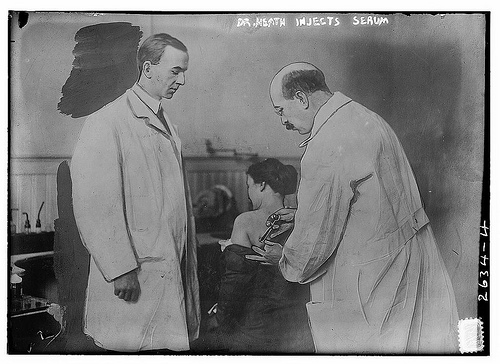
We're making women crazy, then acting like there's something wrong with them for being crazy.
I made an appointment with a psychiatrist who, naturally enough, prescribed anti-depressants. Makes sense, right? Because by the time I dragged myself into her office, I was really, really depressed.
I was also really, really anxious. I was having horrible, crippling panic attacks almost daily, and I was waking up in the middle of the night, shaking, heart pounding, unable to go back to sleep.
The anti-depressants were supposed to help with this also. Unfortunately, they made me jittery. Now, on top of the anxiety I was already grappling with, I couldn’t sit in a chair without jiggling my knee up and down. They gave me other weird side effects: night sweats, headaches, cotton mouth. I started having a lot of trouble sleeping, but it was hard to tell whether it was a side effect of the anti-depressants, since I’d been having trouble sleeping when I was working, too.
So my psychiatrist wrote me a prescription for pills to help me sleep.
Things slowly started to get better for me. Summer came and went. I stopped feeling depressed. I quit my job for good. I started eating like a normal person. But still, I couldn’t get a decent night of sleep without taking a sleeping pill.
I quit coffee and chocolate and started doing a lot of yoga and meditation. Still, I couldn’t sleep without pills. If I didn’t take them, I would wake up between 1 and 3 am, heart pounding, and stare at the ceiling for a good two hours before I could sleep again. After several months of this, I developed an eye twitch.
My psychiatrist, who was intelligent, thorough, and sincere, suggested I do a sleep study. I packed up my pillow, kissed my husband and the kids good night, and drove to a sleep lab in Berkeley. There, a young women with pale skin and dyed black hair skillfully strapped me to various machines designed to monitor breathing, leg movements, brain waves, and God knows what else.
Naturally, I had another terrible night’s sleep. Which was sort of good news…
When the results came back a few weeks later, there were pages and pages of detailed findings. There was a problem with my breathing, with my “index of sleep arousals” and with something called RERAs, an intriguing acronym that was never spelled out. In short, I had a “moderate” version of sleep apnea.
My doctor called as soon as she got the results.
“This could be what’s causing your depression!” she said. “We need to get you an apnea machine so you can breathe at night. Katrina, if this works, then all your problems may vanish!” She was triumphant. I was hopeful.

Six kinds of CPAPs. Because if we can't choose a less stressful life, at least we can choose the most comfortable nose plugs.
Back I went to my HMO. A respiratory nurse named Joan patiently outfitted me in the latest artificial breathing technology, a CPAP (pronounced SEE-pap) machine.
“Our newest model,” said Joan.
The machine itself was slightly larger than a lunchbox, a dark designer gray, with a corrugated hose that looped over my head and three slim black straps that held rubber nose plugs snug to my face.
“I gave you a medium,” Joan said, looking critically at the nose plugs, which were now plugged into my nose. “If that doesn’t work, you can try the large.”
The large? I thought. I am not a large person. Is my nose really so out of proportion to my body?
But it was not the time to be vain.
Joan snapped on the machine. Oxygen flowed up the vacuum-cleaner hose on top of my head and through the nose plugs. When I opened my mouth, air came whooshing out, like I was some kind of human leaf blower.
“Don’t open your mouth,” Joan said.
I closed my mouth and nodded.
That afternoon, I took the machine home for a two-week trial. I hated the Darth Vader breathing sounds, the itchy nose plugs, sleeping with a hose on my head…but I used it diligently. If it worked, I was going to have to buy one—about $1,000. My insurance wasn’t going to pay for it, so I had to be sure it was right for me.
After ten days, I caught one of the worst head colds I’ve ever had. I couldn’t breathe through my nose at all, so I gave up on the machine. I was still sick when I brought it back to Joan.
“I don’t think it helped,” I said. I could see she was disappointed. We stared sadly at each other for a moment. I sneezed. She wrote me a referral to see a pulmonary doctor that afternoon.
The first question the pulmonary doctor asked was, “Are you sleepy during the day?”
“Tired? Yes. Sleepy…not really.”
“Do you take naps?”
“I find it hard to nap,” I sniffled. “I mean, I find it hard to sleep. Period.”
“If you’re not sleepy during the day, then you don’t have sleep apnea.”
“What about the sleep test?”
“There are different ways to interpret the results,” she said. “But the breathing issue that came up, that could be from the sleeping pills you’re taking. They depress the central nervous system. They could definitely cause shallow breathing. Especially if you’ve been taking them for a while.”
“I’ve been taking them for ten months.”
“That could do it.”
“But it I don’t take them, I can’t sleep!”
“Yes, the antidepressants you’re on can cause insomnia in some individuals.”
We smiled at each other. Because the whole thing was so stupid.
“And on top of it all, I got this horrible cold,” I said, because suddenly I was feeling really sorry for myself.
“Oh, yeah, I see that all the time,” she said. “The CPAP can dry out your nasal passages and make you more likely to catch a virus.”
Let’s recap here:
1. Trying to work full time and raise young kids put my body under unendurable strain.
2. My body broke down.
3. The doctors decided that something was wrong with me, so they prescribed pills.
4. Those pills made it impossible to sleep, so they prescribed more pills.
5. The second pills depressed my breathing and made it look like I had sleep apnea.
6. The doctors gave me a machine to treat the sleep apnea, which dried out my (medium-to-large) nose and made me sick.
!
I called my doc and told her the whole story.
“In conclusion,” I said, after pausing for a breath. “I don’t think there’s anything wrong with me. I just needed to quit my job, which I did. Now the only thing making me sick is the meds.”
“There’s a word for this,” she said thoughtfully. “Iatrogenic. It means ’caused by the doctors.'”
Here’s my diagnosis: It is crazy to put working parents in impossible situations where they are bound to go crazy, and then act like there’s something wrong with them for going crazy.
Why am I telling you this story? Because there is a public health crisis afoot. We are suffering from a chronic state of busyness, particularly families with young children and two working parents.
We are also suffering from our adherence to a childish ideal of rugged individualism, which keeps us from supporting each other and from asking for help when we need it. This is not an individual pathology that can be solved with a pill (the effectiveness of which is now debatable) [1], but a massive cultural pathology that dictates everything from our individual relationships to laws and workplace policies that fail to support working families.
Make no mistake—at every step of this bizarre journey, I was in the hands of a competent and caring health care professional. They used every ingenious tool at their disposal to help me. The problem was, they didn’t have the right tools. Where I needed work that challenged me without sucking the life out of me, they had anti-depressants. Where I needed someone besides my overworked husband to watch the kids for a Saturday, they had sleeping pills. Where I needed the support and encouragement of my peers, they had breathing machines.
So I’ll leave you with this question: If our doctors can’t help us, then who can?
Cross-posted with the Huffington Post and MomsRising.
[1] NEWSWEEK, “The Depressing News about Antidepressants: Studies suggest that the popular drugs are no more effective than a placebo. In fact, they may be worse,” by Sharon Begley, February 8, 2010





{ 20 comments… read them below or add one }
Wow — no wonder we need health care reform! So much of the stress on the system and profiteering by the insurance industry is driven by social and economic pathology. This syndrome also tracks with what makes the US so different from other “advanced” industrial societies.
Katrina, You state so clearly and so candidly the rat race we live in. I am a single Mom by choice and I participate in the system because I have to. What other choices do we have?
No pill in the morning! Congratulations! That’s huge. I have been on the roller-coaster of anxiety/depression medications myself and I know what a big deal it is to be DONE.
I wish also that more people had the opportunity to dissect/question their own involvement/dependence on medication. That’s one of the tricky things about this rat-race we’re in, our heads are down and we just keep going. We’ll do whatever it takes to just keep going- especially if “answers” to our “problems” come from “trusted” sources like our doctors and they are easy (swallow a pill)…… Thank you for your story- I hope that it inspires others to take a look at their symptoms and their potential causes beyond what the doctors prescribe.
katrina, thank you for this post. once again, your story completely resonates with my own experiences as a working mom…i am excited to read a future post about your post pills successes, and future explorations around how we can reduce the stress (while trying to juggle so much) so we do not run ourselves into the ground, and therefore do not have to look to western medicine for answers.
Katrina, your article is absolutely amazing. From a former psychotherapist and a fellow mom, thank you for your sincerity and your story. I cited you in my blog post today if you would like to see it http://thefunnyfarmer.blogspot.com/. Good luck to you and your may the withdrawal Goddesses be kind 😉
This is an amazing story — life is stranger than fiction! I just wanted to mention that if you haven’t already, perhaps you should try seeing an acupuncturist or a chiropractor (I can name a few that incorporate energy work and help gently integrate the body). I have a feeling that people could avoid this whole pill-forsaken mess by seeing either of these practitioners; each can help your body (and mind) find its balance again. I’ve had amazing success with acupuncture in treating sleeping issues, stress, anxiety, and the emotional rollercoaster of life. You don’t always have to turn to doctors for these things!
@Cherie–I just read your post and loved it. Thank you for sharing it here.
@Jessie–I didn’t put this in the original blog post because it was already really long, but believe it or not, medication was a LAST resort for me after many years of trying alternative therapies (including acupuncture and chiro). Maybe I’ll write up that story next…To be continued!
“Here’s my diagnosis: It is crazy to put working parents in impossible situations where they are bound to go crazy, and then act like there’s something wrong with them for going crazy.” – AMEN!
I have been drinking in all the comments and posts on your blog. It has been extremely validating to see that I am not the only one looking around me wondering “am I the only one who feels crazy inside?” There’s a cultural epidemic happening to our families and to our women and no one knows what to do. I truly appreciate the intentions of the feminist movement and respect the people who pioneered changes for women, but sometimes I feel like “well, I have more opportunities and choices but now I am expected to develop a career AND continue in the domestic roles of a woman” It just feels like we can’t win no matter what we try to do……Thank you so much for taking on this topic and reaching out to the many women who are overwhelmed.
My thoughts — and experience — exactly. I”m going on 3 years of chronic stress due to full-time+ work and parenting two young daughters (now ages 4 and 6). After 2 years of chiro, acupuncture, Rolfing, massage, cranial sacral — I truly tried it all! — I resorted to anti-depressants (Cymbalta). They worked like a charm but caused side-effects. And I hated the idea of taking them, took myself off of them (pure hell for 2 weeks), tried natural alternatives (didn’t work), and am now faced with the reality that I need to cut back or possibly quit my job. So my question is: did quitting your job work? Are your stress symptoms gone? I’m debating whether to negotiate a job share or quit altogether. I want my health back! — Many thanks, emily
I’m so impressed with all the things you tried. (How was cranial sacral?)
In my case, quitting worked. I still get stressed, because life is still life, but nothing like the relentless, chronic stress of working full time, commuting, and having very young kids. I’m also lucky that it was easy for me to fall back into a freelance career–not everyone has that option.
If cutting back or doing a job share seems like a viable option, maybe you could try that before quitting? You can always quit if that doesn’t work out.
Normally I don’t read post on blogs, but I wish to say that this write-up very forced me to check out and do so! Your writing taste has been amazed me. Thanks, quite great article.
Good day! Would you mind if I share your blog with my zynga group?
There’s a lot of people that I think would really enjoy your content. Please let me know. Cheers
Wow. I wish I could make my boyfriend believe me that Prozac is not good for him . Our life has changed a lot of since he start taking the medicine. I love him but I can not stay with him there is not way for me to convince him to quit taking Prozac I told his doctor he insist I am laying .
If you wish for to get a great deal from this article then you
have to apply such methods to your won website.
I finally found information that I can relate to! This is my story plus add in a shift working husband who works 12 hour shifts either days or nights with one weekend off a month, virtually no support system, and no overnight daycare available. I haven’t thought about quitting my job because it is the stable one in the family. My husband works at a mine and could loose his job at anytime if the mine were to shut down. I am single parenting much of the time. My youngest (4) is an extremely challenging child (very determined personality.) Everyone says it is just because he is intelligent and it will payoff in the end but to me it is mentally and physically exhausting. I took myself off Prozac about six months ago because I had a theory that the reason I couldn’t sleep was because of Prozac. Also, I had a CPAP and couldn’t stand it. Low and behold, I am sleeping like a charm now and I don’t think I ever had sleep apnea, I think it was the Prozac. The sleep test came back with results that were borderline anyway….. I am stuck. I am angry most of the time. I exercise daily and eat well. I am not overweight. So I think I am doing all of the “right” things. Where do I turn next? I don’t want to be on meds. I don’t even like taking ibuprofen.
I think I am traumatized by the 2 years of being messed with by the medical, substance abuse, and mental health Industries’. Its damn near ruined my life.
GRACE ALONE THROUGH FAITH ALONE IN CHRIST ALONE! Thats the only prescription you need and the cost is free! 🙂
I’ll immediately clutch your rss feed as I can’t in finding
your e-mail subscription link or e-newsletter service.
Do you’ve any? Kindly permit me understand in order that I may just subscribe.
Thanks.
What if your old and don’t work? What if your a grandmother? I’ve had insomnia my whole life. It’s called stress period, but… If I didn’t have my fd up sleeping pills I’d be dead! Still wake up at night. Not suppose to take them I mean them for over a week, huh months!!!!
My life sucks period. There isn’t a pill on this planet that would fix it but my own place to live.
{ 2 trackbacks }